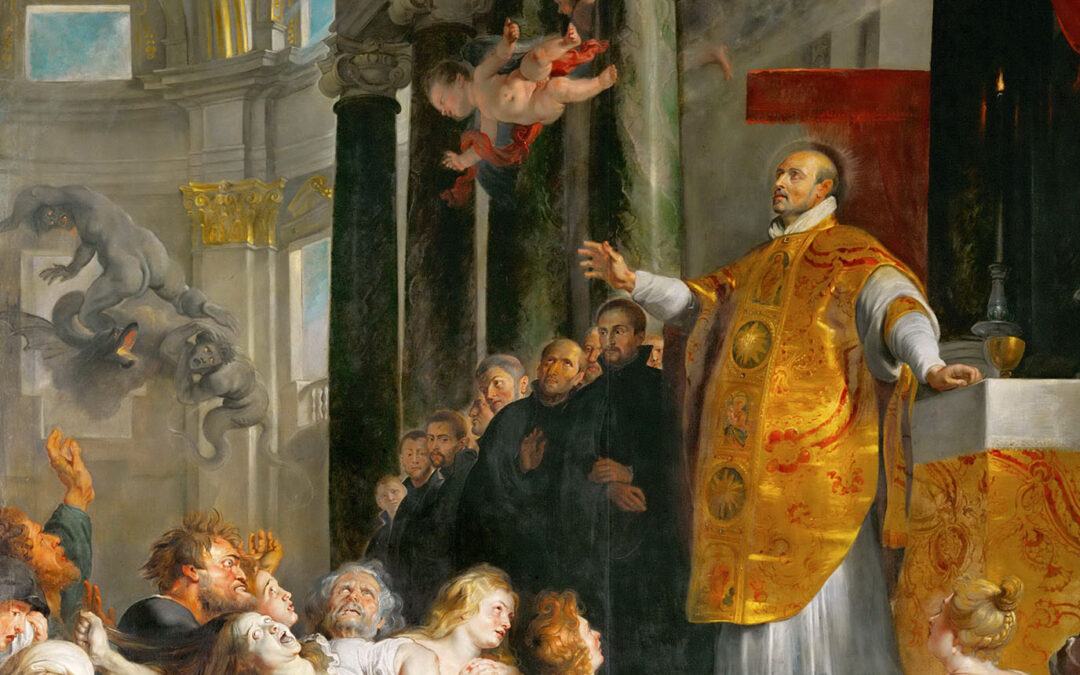
Image: Miracle of St. Ignatius (detail, ca. 1617), Peter Paul Rubens.
On the occasion of the feast of St. Ignatius, we would like to highlight an aspect of the spirituality of the saint of Loyola in the Servants of Jesus.
Article 6 of our Constitutions recognizes and explains the spiritual paternity of St. Ignatius of Loyola over the Servants of Jesus. This paternity is part of the history of our founder, Father José Manuel Pereda Crespo – who received his religious formation from the Jesuits – as well as that of our institute, which from its beginnings has given great importance to the Spiritual Exercises:
With the greater glory of God as our goal, we, the Servants of Jesus, place under the spiritual paternity of St. Ignatius of Loyola the following of the Lord that we are called to live and we configure it according to the way of proceeding that he proposes in his Spiritual Exercises. For this reason we consider essential elements such as: contemplation of the Word of God, especially the mysteries of Jesus Christ, our Lord, in order to love and follow Him more; permanent conversion; apostolic and priestly service; obedience to the hierarchical Holy Mother Church; always remaining in the discernment of spirits. (Constitutions of the Servants of Jesus, art. 6).
The article recognizes St. Ignatius as a true spiritual father, that is, someone who does not point to himself, but points us to our Lord – who is the one who has called us – and teaches us to love and follow him, always seeking “the greater glory of God”.
Contemplation of the word of God, with special emphasis on the mysteries of Jesus “in order to love and follow him more” (EE 104), is considered essential for the Servants of Jesus. This, inseparably united – in the spirit of the first week of the Exercises – to permanent conversion, allows us to carry out a concrete service in the Church: “apostolic and priestly”, seeking to live in ecclesial obedience and in the discernment of spirits.
“…the more to love Him and follow Him.”
All this is based on an essential aspect of Ignatian spirituality: “the more to love and follow him”. For St. Ignatius, God is always greater, always greater, and for this reason he insists on loving and following Jesus more and more, who always has more to give us, and always desires to give us more. For this we need “inner knowledge of the Lord” (EE 104), that is, to be with him, to know him intimately, to be familiar with him, to decide for him, to give him access to our heart and to contemplate his, to allow ourselves to be introduced into his “way of proceeding”, to accept the friendship he offers us and to live among ourselves that mysterious being “friends in the Lord”.
This inner and personal knowledge, which, as opposed to a merely external and functional knowledge, leads to that “more loving and following” of the Lord, has the potential to transform us in such a way that Jesus is recognizable in us: “I live, but it is not I, it is Christ who lives in me” (Gal 2:20). At the same time, it makes us recognize that we are sinners and yet we are called by the Lord to be with him, to love him, to follow him and to serve him: “Whoever wishes to come with me must work with me, so that, following me in sorrow, he may also follow me in glory” (EE 95).
Let us remember the call we received
Each Servant of Jesus must continually remember the call he received and be grateful for it, so that, “fully recognizing it, he may in all things love and serve his divine majesty” (EE 233), with a trusting dedication to him. In this, as Pope Francis teaches us, we must place ourselves in the school and under the intercession of Mary so “that she, who was the first and most perfect disciple of her Son, may help us to allow ourselves to be won over by Christ in order to follow and serve him in every situation”(Homily, July 31, 2013).
P. Luis Guillermo Robles, S. de J., Vicar General of the Servants of Jesus